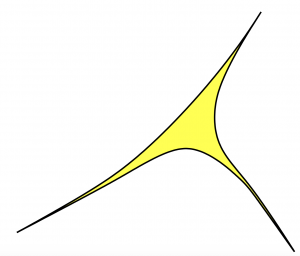
A small fragment of Misha Gromov’s work
Etienne Ghys
Translated by S. Matveev in 2025 from the French original published in 2009 at Images des mathématiques
For centuries, geometry was Euclid’s geometry — the one we learn in school, with its right, isosceles and equilateral triangles and its theorems of Pythagoras and Thales; the geometry of “the world in which we live.” Euclid established its foundations in the third century BCE in the book — a landmark for mathematicians, titled “The Elements”. For more than twenty centuries, this book stood at the heart of mathematics, so definitive did it seem.
Yet one of Euclid’s axioms — a statement he asked readers to accept at the beginning of his book without proof — left a lingering unease: “Through a point chosen outside a given line, it is possible to draw exactly one line parallel to the given one.” Generations of mathematicians tried to deduce it from the other, seemingly more natural axioms. Many believed they had succeeded; many were mistaken.