
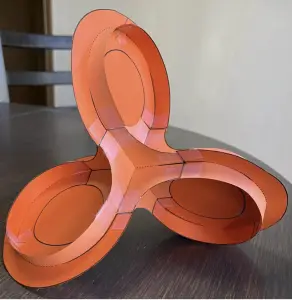
Build Boy’s Surface
ARTICLE BY
RICHARD EVAN SCHWARZ
These notes give a fairly conceptual description of Boy’s surface that does not draw too much on three dimensional visualization. I will explain how to build Boy’s surface out of simple pieces.
ARTICLE BY
RICHARD EVAN SCHWARZ
These notes give a fairly conceptual description of Boy’s surface that does not draw too much on three dimensional visualization. I will explain how to build Boy’s surface out of simple pieces.
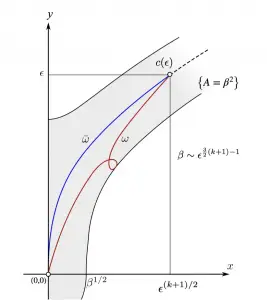
AUTHOR: R. Montgomery. Are all subRiemannian geodesics smooth? The question was answered recently with a decisive “no” by Yacine Chitour, Fr´ederic Jean, Roberto Monti, Ludovic Rifford, Ludovic Sacchelli, Mario Sigalotti, and Alessandro Socionovo.
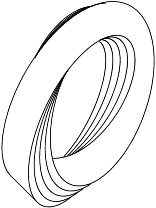
AUTHOR: Sergei Tabachnikov. Everyone knows how to make a Moebius band out of a paper rectangle: give it a $180^{\circ}$ twist and attach the ends to each other. It is easy to do if the rectangle is long and narrow, but it is impossible if the ratio of the length to width is sufficiently small (say, equal to 1). Thus there exists a number $\lambda$ such that if this ratio is greater than $\lambda$, a paper Moebius band can be made, and if it is smaller than $\lambda$, then a paper Moebius band does not exist.
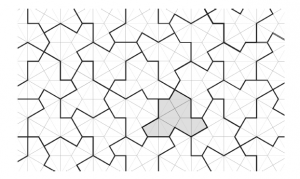
AUTHOR: Marjorie Senechal. “A longstanding open problem asks for . . . a shape that admits tilings of the plane, but never periodic tilings. We answer this problem for topological disk tiles by exhibiting a continuum of combinatorially equivalent aperiodic polygons.”
Thus begins the abstract of the preprint “An Aperiodic Monotile,” first posted on arxiv.org on March 20, 2023 by David Smith, Joseph Myers, Craig Kaplan, and Chaim Goodman-Strauss ([1]). Propelled by social media, lively international Zoom gatherings, on-line science magazines, and The New York Times, the news streaked around the globe at (nearly) the speed of light.
AUTHOR: V. Ovsienko. The goal of this short review is to explain the main ideas of the emerging new theory. of “quantum rational’,’ based on modular, or PSL(2,]-invariance,
and that of “quantum irrationals”.
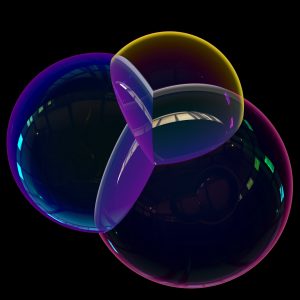
AUTHOR : F. Morgan : EDITORS : J. Hass, R. Ghrist : ART : R. Ghrist In 1884 Hermann Schwarz proved that a single round